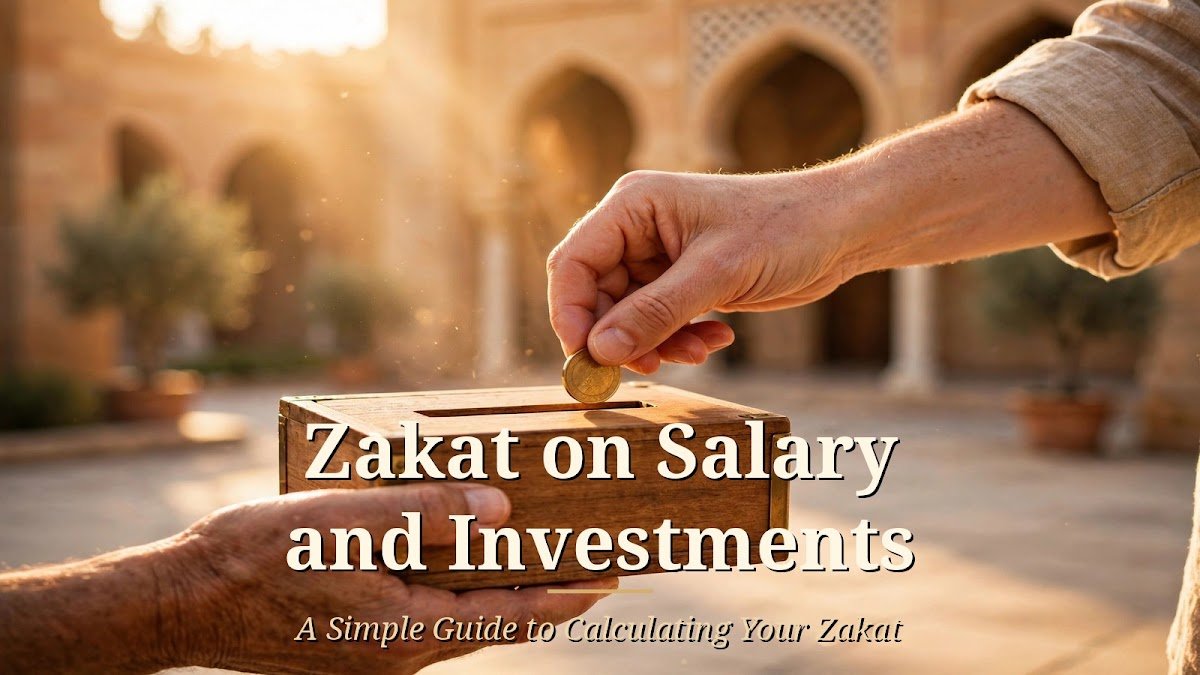

Imagine your wealth as a garden. Just as a gardener prunes branches so the tree grows healthier and bears more fruit, Zakat is the beautiful pruning Allah has prescribed for our wealth: it purifies it, increases its blessing, and lets goodness flow to those who need it most. For every Muslim who earns a salary, saves money, or invests for the future, understanding Zakat on salary and investments is not just a duty — it is a door to peace of mind and true barakah in your income.
In this simple, practical guide, we explain how Zakat works on your salary, savings, stocks, and other investments: what counts, what does not, how to calculate it step by step, and the most common mistakes to avoid. No complicated terminology — just clear answers you can apply today.
Watch: Dua for Needs, Relief and the Opening of Rizq Doors

What Is Zakat, and Why Does It Matter?
Zakat is one of the five pillars of Islam — an obligatory charity of 2.5% of certain types of wealth, paid once a year. Allah says: "Take from their wealth a charity by which you purify them and cause them increase" (Qur'an 9:103). Giving Zakat does not decrease your wealth — it purifies and increases it.
The Two Golden Conditions: Nisab and Hawl
- Nisab: your zakatable wealth must reach the minimum threshold — the silver nisab of 595 grams of silver (or 85 grams of gold).
- Hawl: you must own it for a full lunar year (~354 days). Pick one Zakat date per year (e.g., 1st of Ramadan) and pay on everything you own that day.
Zakat on Your Salary: The Practical Method
- Choose one fixed Zakat date each lunar year.
- On that date, add up all money you own: bank balances, cash, money owed to you — including leftover salary.
- If the total reaches nisab, pay 2.5% of the total.
Some people pay monthly in small advance installments, then settle the exact amount on their Zakat date — permissible and lighter.
Zakat on Savings and Cash
All cash and bank savings count — checking, savings, cash at home, debts owed to you. Money set aside for a wedding, house, or education is zakatable if saved and reaching nisab.
Zakat on Stocks and Investments
- Trading stocks: pay 2.5% on the full market value on your Zakat date.
- Long-term holdings: many scholars say pay on the zakatable assets per share; paying 2.5% on market value is a safe, generous option.
- Mutual funds/ETFs: same principle — trade-oriented: market value; long-term: reasonable estimate.
- Retirement accounts: if accessible, include current value; if locked, many scholars say Zakat is due when received.
Important: keep investments in halal, Sharia-compliant companies and funds.
Zakat on Gold, Silver, and Jewelry
Zakatable once reaching nisab (85g gold / 595g silver) with a year passing. Including regularly-worn jewelry is the more cautious choice.
A Simple Worked Example
On your Zakat date: savings $8,000 + cash $500 + stocks $4,000 + gold $1,500 = $14,000. Zakat = 2.5% × $14,000 = $350.
Common Mistakes to Avoid
- Forgetting debts owed to you.
- Ignoring small amounts across accounts.
- Delaying payment without excuse.
- Giving Zakat to ineligible recipients (Qur'an 9:60 lists the categories).
- Thinking taxes replace Zakat — they are separate obligations.
Frequently Asked Questions
Do I pay Zakat on my salary before or after expenses?
After — on what you still own (savings) on your Zakat date.
What if my investments lost value?
Pay on the current market value on your Zakat date.
Can I give Zakat to a family member?
Yes — to poor relatives you are not obliged to support.
Should I tell the recipient it is Zakat?
No — give discreetly to protect their dignity.
What if I missed Zakat in previous years?
Estimate each missed year and pay now.
A Final Word: Give Joyfully
Calculate it carefully, pay it promptly, give it joyfully — May Allah accept your Zakat, purify your wealth, and bless your income and your family. Ameen.